

On November 20, 2025, a Nigerian court convicted Nnamdi Kanu, leader of the Indigenous People of Biafra (IPOB). He was charged with seven terrorism-related charges, sentencing him to life imprisonment. This ruling has significant implications for Nigeria’s legal and political landscape. According to the ruling by Justice Omotosho, Mr Nnamdi Kanu ought to be given a death sentence. However, he showed him clemency because God has also done the same to us. Moreover, the death sentence is no longer fashionable in the world.

Background of Nnamdi Kanu and IPOB
Nnamdi Kanu, born on September 25, 1967, in Isiama Afara, Nigeria, is a British-Nigerian political activist advocating for the secession of southeastern Nigeria to form the Republic of Biafra. He founded IPOB in 2012, aiming to restore the defunct Republic of Biafra, which existed during the Nigerian Civil War from 1967 to 1970. Kanu gained prominence through his inciting broadcasts on Radio Biafra, a London-based station. These broadcasts criticised the Nigerian government and called for violence over Biafran independence.
Charges Leading to Conviction
The Nigerian government charged Kanu with multiple offences, including inciting violence, issuing sit-at-home orders, providing bomb-making instructions, and leading a proscribed organisation. In addition to inciting violence during the Lagos ENDSARS riots. The court found that Kanu’s actions violated Nigeria’s sovereignty and public order.
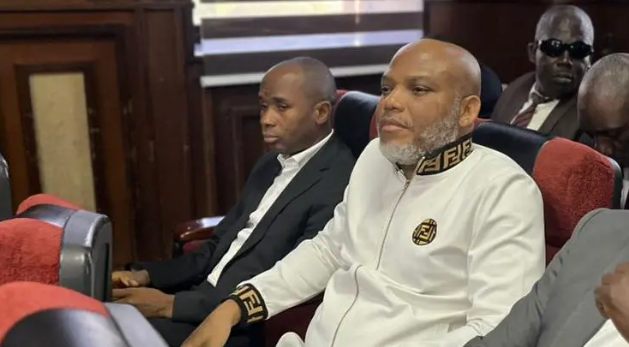
Unruly Behavior in Court
During the trial, Kanu exhibited disruptive, rude and uncanny behaviour. Furthermore, he dismissed his legal team and refused to defend himself, claiming the charges were unconstitutional. He was, however, ejected from the courtroom for raising his voice and accusing the judge of bias.
Consequences of the Ruling
The conviction carries several significant implications, affirming the classification of IPOB as a terrorist organisation. Nevertheless, the sentencing may influence more separatist movements in southeastern Nigeria. Conclusively, the sentencing highlights Nigeria’s complex approach to handling separatist activities. However, the situation remains a mix-bag since agitation and terrorism require clear separation.
Mr Luke Okechukwu expressed sadness over the ruling, suggesting that a political solution could have brought peace instead of relying solely on the judicial process. Additionally, Mrs Adaora Okoro recalled the trial’s long history and the attack on Kanu’s ancestral home in 2017, stating that followers of the proceedings found the life imprisonment sentence unsurprising.

Reactions from Victims and the Public
The conviction of Nnamdi Kanu, leader of the Indigenous People of Biafra (IPOB), on seven terrorism-related charges and his subsequent life imprisonment have elicited varied reactions from different groups and individuals. While some victims of Kanu’s actions feel that justice has been served, others express dissenting views.
Nnamdi Kanu Transfered to Sokoto Prison
Nnamdi Kanu, leader of the proscribed Indigenous People of Biafra (IPOB), convicted of terrorism charges, moved from the Department of State Services (DSS) detention centre to Sokoto Prison. Legal and security considerations amid ongoing proceedings related to his arrest prompted this move. The transfer places Kanu in a high-security facility, reflecting the seriousness of the charges against him. His supporters express concern over the move, fearing for his safety and calling for fair treatment. Nigerian authorities maintain that the transfer follows legal protocols and forms part of ongoing judicial processes. People expect further updates as the legal proceedings continue.

Conclusion
Nnamdi Kanu’s conviction on terrorism charges highlights the complexities of Nigeria’s internal conflicts and the challenges in addressing separatist movements. The case has attracted international attention, prompting discussions on human rights, legal processes, and the balance between national security and individual freedoms. As Nigeria continues to navigate these challenges, the implications of this ruling will likely influence future policies and the discourse surrounding self-determination and national unity.