

For decades, Nigeria’s energy story showed a glaring contradiction. Africa’s largest oil producer failed to refine enough fuel. That chapter has now closed.
In March 2026, Dangote Petroleum Refinery & Petrochemicals achieved a historic milestone. It exported 44,000 barrels per day of petrol. This surpassed Nigeria’s import volume of 41,000 barrels per day. Consequently, Nigeria became a net exporter of refined petroleum products.
The refinery’s rise to full capacity marks a seismic global energy shift. Previously, Nigeria imported nearly all its fuel. This drained precious foreign reserves and exposed consumers to global price shocks. Now, this transformation carries implications far beyond Nigeria’s borders.
From Import Dependency to Export Powerhouse
The numbers paint a dramatic picture of change. According to market intelligence firm Kpler, Nigeria’s petrol imports in March 2026 fell to just 41,000 b/d. That is a significant number, as data shows it is the lowest level ever recorded in Nigerian history. The Dangote Refinery’s contribution to the domestic market surged significantly. In October 2025, it stood at 31.23 per cent. By March 2026, it rose to 72.30 per cent.
This growth resulted from overcoming technical hurdles. Additionally, the refinery pushed capacity utilisation to 93.62 per cent. Consequently, the facility dramatically increased its market impact within a short period. To put this achievement in context, Nigeria had no petrol exports in January and February 2026. The March surge to 44,000 b/d marked a complete reversal in Nigeria’s refined product trade position.
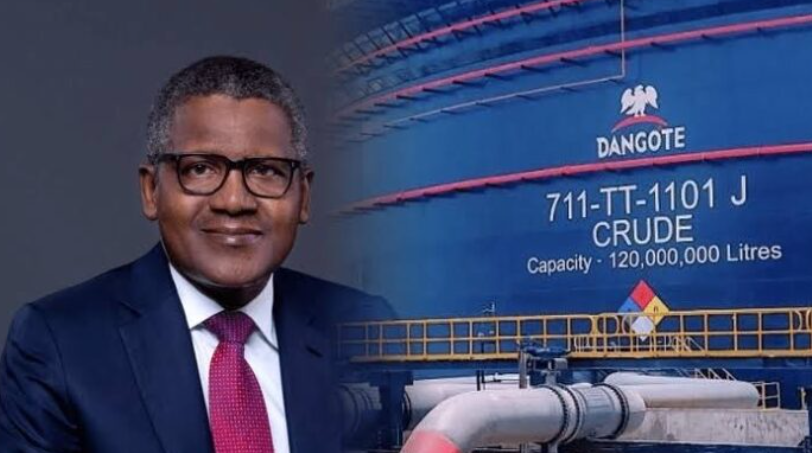
Aliko Dangote, Africa’s richest man, credited the supportive policy environment under President Tinubu’s administration. He emphasised that the milestone resulted from strong government backing, not from isolated efforts.
Central to this support is the naira-for-crude policy, approved in July 2024. This policy allows NNPC to supply crude oil to Dangote Refinery using naira as payment. Consequently, the mechanism guarantees supply security and ensures full petroleum product availability. Moreover, it eliminates fuel queues and shields Nigeria from scarcity affecting other nations.
A Game-Changer for African Energy Security
The significance of Dangote’s achievement extends well beyond Nigeria’s borders. Consequently, East African buyers now turn to Nigeria. They previously depended on Middle East Gulf supplies. However, geopolitical instability disrupts traditional shipping routes. Specifically, the ongoing Iran conflict affects the Strait of Hormuz. This waterway remains a vital global chokepoint.
Accordingly, in March 2026, the refinery loaded its first East Africa cargo. It shipped 317,000 barrels of petrol to Mozambique. Moreover, a second shipment reaches Beira Port in April. This signals a durable shift in regional trade flows.
Indeed, the demand surge has been dramatic. For context, the Middle East provides roughly three-quarters of refined-fuel imports. These imports supply East and Southern Africa. Additionally, the Iran war disruption leaves governments scrambling. Subsequently, countries now turn to the Dangote Refinery for supply. These nations include Ghana, South Africa, Kenya, Tanzania, and Côte d’Ivoire.
Operational Challenges and the Path Forward
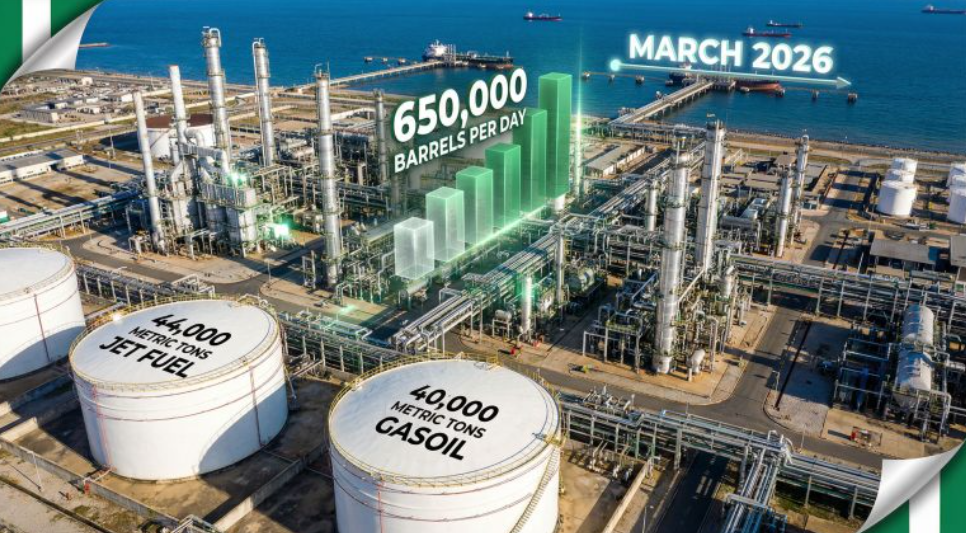
Despite the historic milestone, the refinery’s journey has not been without hurdles. Consequently, between October 2025 and mid-March 2026, the facility faced a crude supply shortfall. This shortfall amounted to about 79.53 million barrels. Specifically, the plant requires an estimated 19.77 million barrels monthly. It needs this to operate at full 650,000 b/d capacity. However, it has consistently received significantly lower volumes. These lower volumes come from domestic sources. Therefore, the refinery has supplemented with imported crude.
Nevertheless, March 2026 brought significant improvement. Specifically, the refinery received ten cargoes of Nigerian crude. This doubled the number received in February. Consequently, its total crude intake reached approximately 565,000 b/d for the month.
Looking ahead, Dangote has signalled even greater ambitions. Notably, the company plans to expand the refinery’s capacity. It aims to go from 650,000 b/d to 1.4 million b/d by 2028. This move would make it the world’s largest refinery by throughput. Concurrently, Dangote enters the higher-value petrochemicals market. Specifically, it partners with Honeywell to produce 400,000 metric tonnes annually. This production covers linear alkylbenzene (LAB) — a core detergent input. Additionally, the partnership will produce 750,000 metric tonnes of propylene yearly.
Broader Implications for the Nigerian Economy
The economic impact of Nigeria’s net exporter status is already unfolding. Consequently, analysts predict the shift will boost foreign exchange earnings. Furthermore, it will strengthen the naira. Additionally, it will reduce the strain on external reserves. This strain has long plagued the economy.
Beyond the immediate financial benefits, the refinery’s success represents a template for industrialisation. Specifically, it serves as a model across Africa. For instance, Edmond Kombat, Managing Director of Ghana’s Tema Oil Refinery, recently called for stronger collaboration. He urged African leaders to maximise the continent’s oil and gas resources. Moreover, he proposed establishing an African benchmark price for crude. He also suggested channelling transactions to domestic refineries. This would keep premium prices affordable for other African nations.
For Nigeria, the net exporter milestone is more than a statistic. Indeed, it is a declaration of energy sovereignty. Consequently, the nation’s energy destiny is now in its own hands. Ultimately, the refinery at Lekki has transformed from a monumental bet into a continental game-changer.
This report draws on data from market intelligence firm Kpler, the March 2026 operational report from the Dangote Petroleum Refinery & Petrochemicals, and supporting analysis from OilPrice.com, Bloomberg, BusinessDay, and the Nigerian Upstream Petroleum Regulatory Commission (NUPRC).