

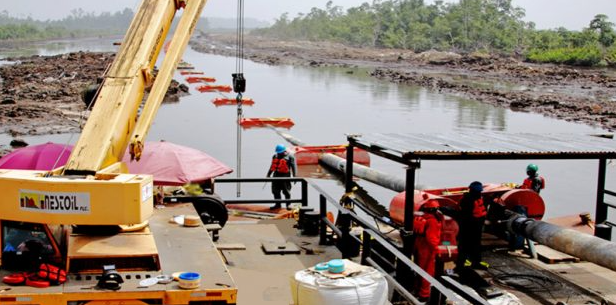
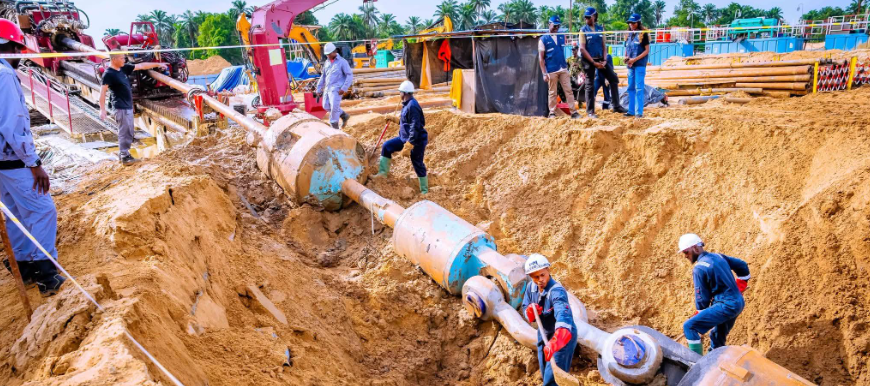
Nigeria’s gas transmission network has strengthened significantly following a major pipeline milestone. The Nigerian National Petroleum Company Limited (NNPC) announced the River Niger crossing completion on April 30, 2026. The NNPC Gas Infrastructure Company (NGIC), a fully owned subsidiary, delivered this achievement. The crossing lies approximately two kilometres beneath the River Niger riverbed. Engineers used advanced Horizontal Directional Drilling (HDD) technology to execute the complex task. HDD remains one of the most demanding engineering feats in Nigeria’s oil and gas sector.
Now, the full operational capacity of the 130‑kilometre Obiafu-Obrikom-Oben (OB3) pipeline is unlocked. This pipeline can transport up to 2 billion standard cubic feet of gas per day. It acts as a backbone infrastructure connecting eastern gas-producing areas to western demand centres. Additionally, the OB3 pipeline extends connectivity northward through the Ajaokuta–Kaduna–Kanoo (AKK) pipeline system. Consequently, Nigeria improves its gas distribution network and energy security. This project supports national efforts to boost industrial growth and power generation. Ultimately, the River Niger crossing marks a critical advancement for Nigeria’s energy sector.
🔧 A Decade‑Long Technical Challenge Finally Overcome
The OB3 pipeline project began in 2016, with the River Niger crossing as its longest challenge. For nearly ten years, this crossing blocked full pipeline activation. Engineers used innovative solutions, adaptive problem-solving, and disciplined governance to complete it. The NNPC project team worked closely with PCE Nig. Limited, a key technical partner.
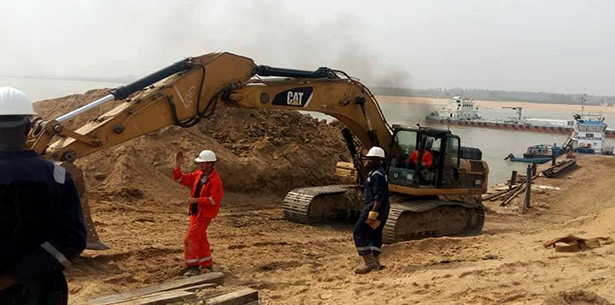
NNPC’s CEO, Engr. Bayo Ojulari, called PCE’s expertise in horizontal directional drilling “pivotal” to success. This achievement built directly on lessons from the AKK River Niger crossing completed in June 2025. Ojulari noted that OB3 leveraged and upscaled capabilities from the AKK project. They tackled even more complex terrain in the Niger Delta environment. Consequently, the OB3 crossing reflects continuous engineering excellence and strategic collaboration. This progress strengthens Nigeria’s gas infrastructure and industry growth.
⚡ Immediate and Long‑Term Impact on Domestic Energy Supply
The successful OB3 crossing will unlock over 500 million standard cubic feet of additional gas supply soon. This extra volume will directly support electricity generation, industrial manufacturing, and regional gas distribution to West Africa. Historically, many Nigerian power plants operated below capacity due to insufficient gas supply. With OB3 fully operational, thermal power stations linked to the national grid will receive more reliable fuel.
This improvement may reduce grid collapses and enhance electricity availability for homes and businesses. For industrial users like cement manufacturers, fertiliser plants, and petrochemical complexes, better gas supply will lower production costs. It will also reduce dependence on diesel and other costly backup fuels. These advancements strengthen Nigeria’s energy security and economic growth prospects.
Industrial users, including cement manufacturers, fertiliser plants, and petrochemical complexes, will benefit from improved gas supply. Consequently, they will lower production costs significantly.
Furthermore, they will reduce reliance on diesel and other expensive backup fuels. This shift enhances operational efficiency and cost-effectiveness. Therefore, better gas supply supports industrial growth and sustainability.
🛠️ Engineering Excellence: Building on the AKK Foundation
Speaking on the development, NNPC’s Group Chief Executive Officer, Engr. Bashir Bayo Ojulari, described the crossing as “a defining milestone for Nigeria’s gas infrastructure and a clear demonstration of what disciplined execution and sustained commitment to excellence can deliver.”
“By successfully traversing one of the most technically challenging sections of the project, we have unlocked a critical link that will enhance gas supply reliability, deepen domestic utilisation, and support power generation and industrial growth across the country.” — Engr. Bayo Ojulari, GCEO, NNPC Ltd
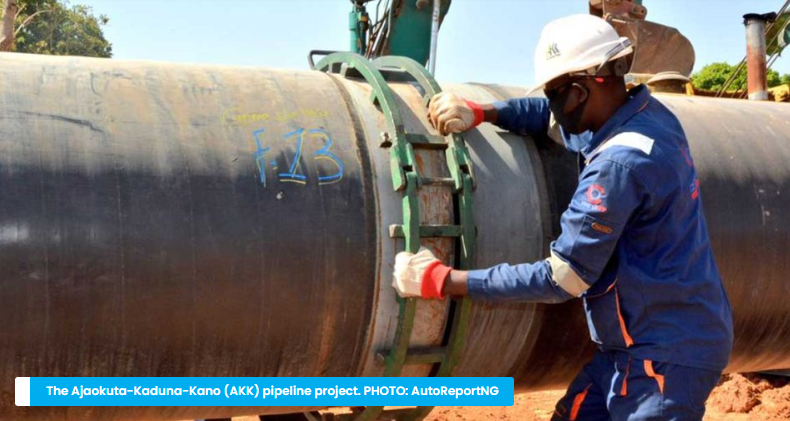
Ojulari emphasised that the achievement was deliberate, not incidental, leveraging AKK engineering standards. The AKK pipeline, a 614‑kilometre, $2.8 billion project, transports up to 2.2 billion SCF/D. It is now over 90 per cent complete, with first gas deliveries to Abuja expected by July 2026. OB3 and AKK pipelines function as interconnected systems. Gas flows from southern producing areas through OB3 before entering the AKK corridor.
The AKK pipeline then distributes gas to northern regions. This integration enhances Nigeria’s gas transmission efficiency and reach. Consequently, the two pipelines support national energy security and economic growth.

🏛️ Strategic Alignment with National Energy Targets
The OB3 completion plays a central role in the federal government’s ambitious energy targets. These include raising crude oil production to 3 million barrels per day by 2030. Additionally, the government aims to increase gas output to 12 billion standard cubic feet per day. These goals underpin the Decade of Gas Initiative, launched in 2021. President Bola Ahmed Tinubu strongly supports this agenda under “Gas for Nigeria’s Prosperity”.
The NNPC Gas Master Plan 2026, launched in January, identifies pipeline expansion as a key pillar. Nigeria currently operates over 2,500 kilometres of gas pipelines. However, the plan estimates that an additional $22 billion investment is necessary. This investment will expand the network to meet projected demand. The plan also aims to increase gas commercialisation from 60% today to 75% by 2027.
Furthermore, it targets 80% commercialisation by 2030. By 2030, monetisation should reach about 80% of produced gas. Infrastructure readiness, sustained investment, and upstream development commitment will support this growth. Consequently, Nigeria’s energy sector stands to transform significantly by 2030.
📈 Regional Connectivity and Economic Implications
The OB3 pipeline serves more than just domestic needs. Moreover, it strengthens Nigeria’s role as a regional gas hub in West Africa. The immediate unlocking of over 500 million SCF/D of incremental gas supply follows. This additional gas will support exports to neighbouring countries directly. Consequently, it enhances regional energy integration significantly. Furthermore, it generates valuable foreign exchange revenue for Nigeria. Therefore, OB3 contributes to both national and regional energy security. This development positions Nigeria as a key energy player in West Africa.
The Minister of State for Petroleum Resources (Gas), Ekperikpe Ekpo, called the OB3 crossing a “pivotal advancement”. Furthermore, he commended NNPC Ltd and its contractors for their professionalism. He also praised their resilience in delivering the project under challenging conditions. This achievement marks a significant milestone for Nigeria’s gas sector. The minister’s remarks highlight confidence in the project’s impact. Such developments promise to transform the nation’s energy landscape. Overall, Ekpo’s statement underscores a commitment to sector growth and innovation.
Ojulari expressed appreciation to the federal government under President Tinubu. He noted the Gas‑to‑Prosperity agenda was instrumental to the project’s success. He also commended the NNPC Ltd board under Chairman Engr. Ahmadu Musa Kida. Additionally, he praised host communities, contractors, and project teams. Their commitment helped overcome technical and environmental challenges. This collective effort drove the project to completion. Ojulari highlighted teamwork as key to success. The acknowledgement reflects strong collaboration across stakeholders.

📊 Key Data Summary: OB3 Pipeline Project
Feature Detail
Project name Obiafu-Obrikom-Oben (OB3) Gas Pipeline
Length: 130 kilometres
Design capacity 2 billion standard cubic feet of gas per day
Owner/operator NNPC Gas Infrastructure Company (NGIC), subsidiary of NNPC Ltd
River crossing method Horizontal Directional Drilling (HDD) technology
Crossing depth approximately 2 kilometres beneath the River Niger riverbed
Technical partner PCE Nig. Limited
Near‑term domestic addition of over 500 million SCF/D of incremental gas supply
Project initiation 2016
Completion date: April 30, 2026
Interconnected systems: OB3 links to the Ajaokuta–Kaduna–Kano (AKK) pipeline (614 km, 2.2 billion SCF/D capacity). Which means it is over 90% complete and expected to begin gas deliveries to Abuja by July 2026.
🔮 Outlook: What Comes Next for Nigeria’s Gas Sector
With the OB3 crossing completed, attention now shifts to final commissioning and the full activation of gas flow through the pipeline. This milestone removes a critical bottleneck that has constrained gas distribution for nearly a decade.
However, significant challenges remain. The $22 billion investment gap identified in the Gas Master Plan will require substantial private sector participation and innovative financing mechanisms, including public‑private partnerships. Additionally, pipeline security and the prevention of vandalism and theft remain ongoing operational concerns.
Nevertheless, for an industry long characterised by project delays and underperformance, the completion of the OB3 River Niger crossing stands as a rare and significant achievement—one that brings Nigeria measurably closer to its vision of a gas-powered industrial economy.
Conclusion
In conclusion, the OB3 and AKK pipelines represent critical milestones in Nigeria’s energy infrastructure. Their successful integration promises enhanced gas supply, economic growth, and regional energy security. Together, they pave the way for a sustainable and prosperous energy future.
All information is based on official announcements from NNPC Ltd, the Federal Ministry of Petroleum Resources, and publicly available project data as of April 30, 2026.